Clear answers when the work can't wait.
A plumbing website has to help two different people: the customer who needs an immediate response and the customer planning a larger project. A good experience gives each a path that makes sense, then helps the office handle the request.

A leak repair and a bathroom remodel are not the same conversation.
Imagine a homeowner dealing with water under the sink. They don't want to describe their budget, project timeline and desired finish in a twelve-field quote form. The site should make a phone number obvious, explain emergency availability accurately, and give a short alternative if calling isn't practical.
Now imagine a customer planning a bathroom renovation. They may be happy to share a project summary, rough timing and photos. This is a different conversation. We design the page and form for the decision at hand.
Urgent, routine, or planned — each gets its own route.
Urgent service
Prominent call button, clear hours and service-area facts as actually supplied. A secondary short request form doesn't promise a dispatch.
Routine plumbing
Description of issue, property type, preferred contact and available scheduling path if the company allows appointments.
Estimates & planned projects
Job category, timeline, photos if technically supported within scope, and a request to discuss next steps. Automatic instant pricing is not assumed.
Honest service lists, real photos, visible contact paths.
Give customers an honest service list. Drain cleaning, leak repair, fixture installation, water heaters and remodel work are distinct, but don't publish a service the plumber doesn't perform. Show actual work photos when available. Make contact paths visible on mobile. Use readable headings that help customers identify a problem. Explain what the team will do after a request.
Treat emergency claims carefully. If the plumber is not open 24/7, don't say '24/7 emergency service' because that's a strong conversion phrase. If an availability window varies, explain how the caller can confirm.
From 'Water heater issue' to a tagged CRM record.
- 01
Customer selects 'Water heater issue'. They supply name, contact, service region, issue and urgency.
- 02
The record reaches the CRM tagged Water Heater.
- 03
The office receives an internal notification.
- 04
A staff member confirms whether the job is appropriate, estimates timing or books the visit.
- 05
The record retains the original context for future follow-up.
This workflow can be configured with forms, pipeline stages and notifications. A chat bot or AI receptionist is not automatically included.
Forms designed like conversations.
We design forms like conversations. Ask for enough to make the next decision. Do not demand information the customer cannot know. Optional fields must look optional. Allow contact preference if useful. Confirm what the business will do with the details. A form that nobody completes is not better because it asks more questions.
Alder & Valve Plumbing.
Warm construction photography, copper accents, a service-choice module, and a high-contrast request button form a distinctly practical design. The point is to make the service business credible and the next action clear.
View the Alder & Valve build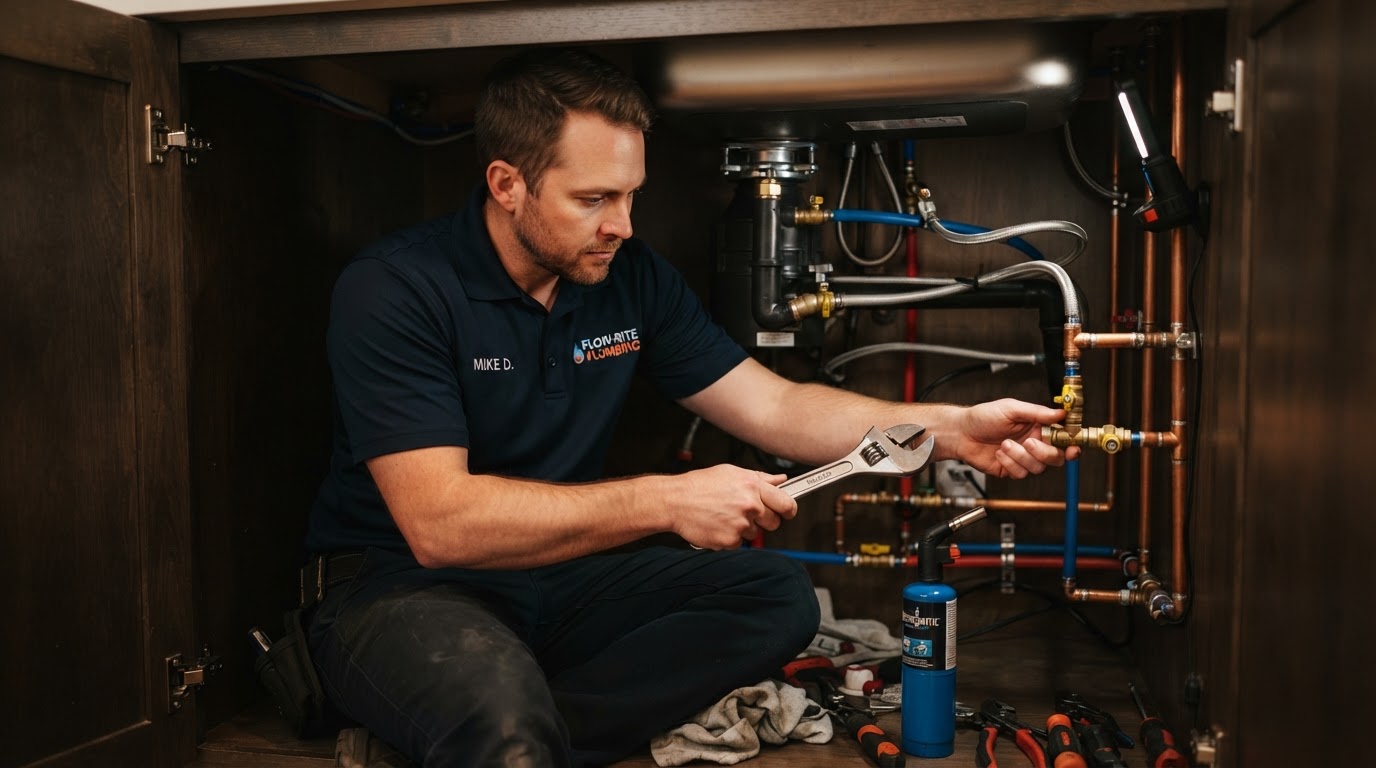
Two ways to buy the same standard system.
The standard connected website and CRM is available through a $2,495 one-time client-owned implementation plus direct HighLevel license, or a $0 setup BGE-managed plan at $397/month for months 1-12 then $197/month from month 13. The standard scope is the same. On the managed plan, the initial 12-month commitment and transfer rules apply. Usage and optional integrations are extra.
Common plumbing website questions.
Does the site book actual service technicians?
Only if the business has a suitable and approved calendar model. Otherwise the form creates a request pending confirmation.
Can customers upload photos of leaks?
We can include basic upload support where the chosen form supports it, subject to file size, data handling and agreed configuration. Any advanced routing is separate scope.
Do you handle SEO?
On-page technical foundations and customer-friendly content are included within six pages. Ongoing SEO is not.
Will an existing plumber's website lose rankings?
We assess current URLs and search signals before replacing a substantive site. A major migration needs separate scope.
A service request should be easier for the customer and the person who answers.
See the connected website in action before you decide.